What to Check Before Buying Phones Wholesale: A Reseller’s Checklist
The checklist professional buyers run before paying for a lot of phones: regional model and carrier bands, a clean IMEI, account locks, new versus refurbished grades, warranty and the paperwork that protects you.

In this article
- 1. Regional model and carrier bands
- 2. Factory unlocked or unlocked later
- 3. A clean, matching IMEI
- 4. Account locks: Apple, Google and corporate
- 5. New, open box or refurbished: know the grade
- 6. Battery, screen and parts
- 7. Warranty, invoice and claims
- 8. Sample before the lot
- Quick checklist
- Phones at EVERIZ
- Frequently asked questions
- Next step
Phones carry thin margins per unit and high dollar values per order. One lot of locked devices, units built for the wrong region or phones with swapped parts can wipe out months of profit. Experienced buyers don’t take “unlocked” at face value: they run through a checklist before they pay. Here’s ours, written for US retailers and for anyone sourcing in Miami to sell in Latin America.
Key takeaways
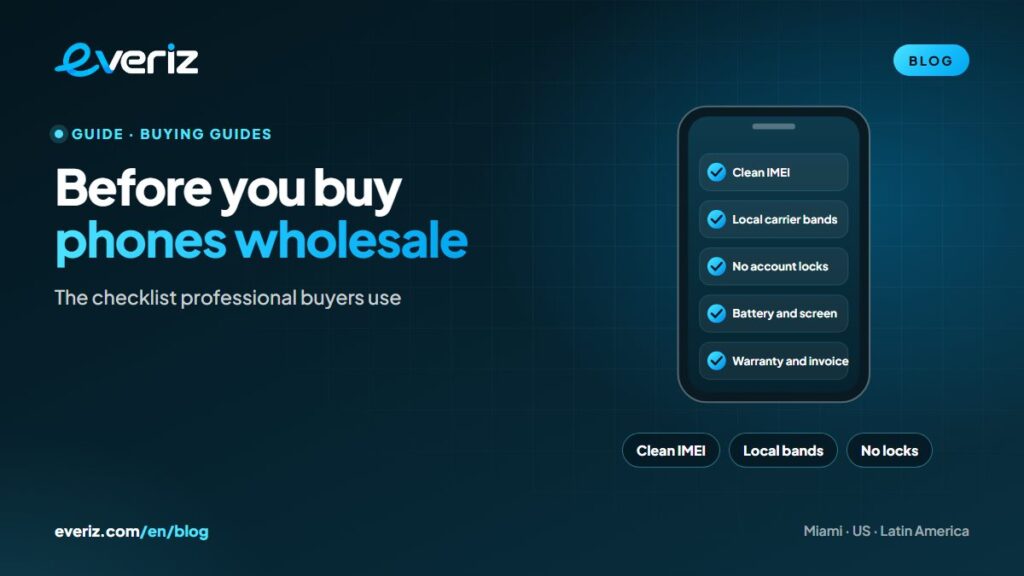
- Confirm the regional model and that it supports the 4G/5G bands used by carriers where you’ll sell it.
- Check the IMEI: it should match the box and the invoice and must not be reported lost or stolen.
- Rule out account locks (Apple’s Activation Lock, Google FRP, corporate device management).
- Get the condition (new, open box or refurbished), warranty and dead-on-arrival window in writing.
1. Regional model and carrier bands
The same phone is built in different versions for different regions, and the model number tells you which one you’re holding (on Samsung, for instance, the final suffix changes). The differences can include network bands, the charger in the box, preloaded languages and warranty coverage. Bands matter most: compare the spec sheet with the frequencies used by carriers in the country where the phone will be sold. Low bands, such as bands 12, 13 and 71 in the US or band 28 (700 MHz) across much of Latin America, are the ones that deliver coverage indoors and outside cities.
Tip: before buying a large lot of a version you don’t know, test one unit with SIM cards from the main carriers in the destination country: calls, 4G data and, if relevant, 5G.
2. Factory unlocked or unlocked later
A “factory unlocked” phone was sold without being tied to any carrier. A phone that was carrier-locked and unlocked afterward may be fine, especially if the carrier released it at the end of a contract, but some unlock methods aren’t permanent. Ask where the devices came from and test them with SIM cards from different carriers.
3. A clean, matching IMEI
The IMEI is the phone’s network serial number. Dial *#06# to see it (dual-SIM phones have two), and make sure it matches the box and the invoice. Then check that it hasn’t been reported lost or stolen. In the US, CTIA’s Stolen Phone Checker queries the GSMA Device Check database, which is fed by carriers worldwide. Keep in mind that it only shows devices that have already been reported. Several Latin American countries also block IMEIs that are reported or unregistered, so a phone that checks out clean in the US still needs to be registrable where you sell it.
4. Account locks: Apple, Google and corporate
- iPhone: Apple’s Activation Lock stays tied to the previous owner’s account. If setup asks for an Apple Account that isn’t yours, the iPhone is locked, and a factory reset won’t fix it.
- Android: Factory Reset Protection (FRP) asks for the last Google account used on the phone if it was reset without removing that account first.
- Corporate devices: phones enrolled in mobile device management (MDM) can lock themselves again after a reset. Be wary of “corporate” lots that come without paperwork.
The simplest test: power on a sample from the lot and get all the way to the home screen without entering any account that isn’t yours.
5. New, open box or refurbished: know the grade
“New” should mean a sealed, never-activated box. “Open box” usually means a new phone whose packaging was opened or returned. Refurbished phones are sold by grade (A, B, C and so on), but every supplier defines its own, so get the criteria in writing: screen and housing condition, battery health, whether parts are original and what warranty applies. “CPO” (certified pre-owned) devices are refurbished units certified by the seller or the manufacturer; ask who issues the certification.
6. Battery, screen and parts
On used or refurbished phones, check battery health and screen condition. On an iPhone that has been repaired, Settings > General > About shows the parts and service history, including whether parts are genuine or “unknown.” A screen replaced with a lower-grade panel shows up in brightness, color and battery drain. Our guide to INCELL, OLED and original screens explains the differences.
7. Warranty, invoice and claims
Manufacturer warranties usually depend on the country where the phone was sold, so ask who covers it and where. Agree in writing on the window for dead-on-arrival (DOA) claims, how returns work and whether you’ll get a replacement or a credit. The invoice should list models, quantities and, ideally, IMEIs: you’ll need it for customs, for warranty claims and in any dispute.
8. Sample before the lot
With a new supplier, buy a sample first and run it through this checklist. If everything checks out, scale up gradually. A reputable supplier won’t mind; one that pushes you to buy the whole lot untested is sending you a signal.
For larger orders, agree up front on what happens if part of the lot fails your checks: which defects are acceptable on refurbished units, how many days you have to report problems and who pays return shipping. Putting it in writing before you pay turns a potential argument into a simple process.
Quick checklist
| What to check | How | Red flag |
|---|---|---|
| Model and bands | Model number and spec sheet vs. destination carriers | “Global version” with no specific model number |
| Unlock status | Test with SIMs from several carriers | Works with only one carrier |
| IMEI | *#06#, box, invoice and an online check | Mismatch, or reported lost or stolen |
| Accounts | Set up a sample all the way to the home screen | Asks for someone else’s Apple or Google account |
| Condition | Written grading criteria | “Like new” with no further detail |
| Warranty | DOA window and return process | “Sold as is” |
Phones at EVERIZ
Alongside accessories and parts, we source wholesale cell phones from brands such as Samsung, Motorola, Xiaomi and ZTE, with availability on request. If you’re looking for a specific model or regional version, ask us and we’ll tell you what we have and in what condition. To round out the order, we also carry cell phone parts such as screens and batteries.
Frequently asked questions
What does “global version” mean on a phone?
It usually refers to the manufacturer’s international version, but it isn’t a standard term. What matters is the exact model number and its bands: compare them with the carriers in the country where you’ll sell it.
Can I check an IMEI for free?
Yes. In the US, CTIA’s Stolen Phone Checker lets you see whether an IMEI has been reported lost or stolen. Remember that it only shows devices that have already been reported.
What happens if I buy an iPhone with Activation Lock on?
You can’t use it without the previous owner’s account, and a reset won’t remove the lock. That’s why every lot should be tested before you pay, with any locked unit going back to the supplier.
Is it better to resell new or refurbished phones?
It depends on your customers. New phones mean less after-sale work; refurbished units can leave more margin if the supplier is reputable and the grades are clear. Either way, a written warranty is a must.
Next step
Run this checklist with every supplier and every lot. To ask about phone availability with us, message us on WhatsApp; if you don’t have an account yet, open a wholesale account and we’ll reply with your tier’s pricing. And if you’re comparing suppliers, see our 10 questions for choosing a distributor.