Power Banks on Planes in 2026: Watt-Hour Limits, mAh Math and the New Two-Bank Rule
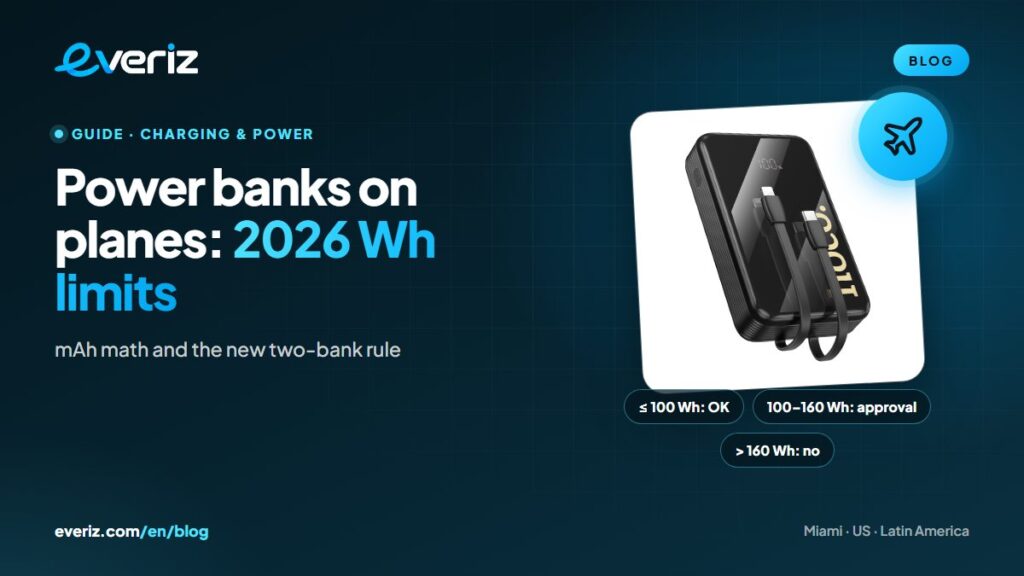
The current rules for flying with power banks: carry-on only, up to 100 Wh without approval, 100–160 Wh with airline approval, a two-per-passenger cap since March 2026, plus an mAh-to-Wh conversion table.

In this article
- Why power banks always ride in the cabin
- How to convert mAh to watt-hours
- The limits: 100 Wh, 160 Wh and airline approval
- What changed in 2026
- How to read a power bank label
- What to tell customers at the counter
- Which capacities to stock
- Buying power banks to resell? Never in your luggage
- Frequently asked questions
- Next step
“Can I take this power bank on a plane?” is one of the most common questions at any accessories counter, especially before the holidays. Answering it well sells product: the customer leaves with the right battery instead of surrendering it at the TSA checkpoint. The rules also changed in 2026, so it’s worth a refresher. Here are the current limits, how to convert mAh to watt-hours and which capacities make sense to stock.
Key takeaways
- Power banks go in carry-on bags only, never in checked luggage.
- Up to 100 Wh is allowed without approval; 100–160 Wh needs airline approval; anything over 160 Wh is forbidden.
- Since March 27, 2026, ICAO limits passengers to two power banks and bans recharging them on board. Several US airlines are stricter.
- A 20,000 mAh power bank is about 74 Wh and can fly. A 50,000 mAh pack is over 160 Wh and can’t.
Why power banks always ride in the cabin
Lithium-ion batteries can overheat and catch fire if they are damaged, get wet or have a manufacturing defect. In the cabin, the crew can spot and handle an incident; in the cargo hold, they can’t. That’s why the FAA requires spare batteries, including power banks and battery phone cases, to travel in carry-on baggage. If your carry-on gets checked at the gate, the batteries have to come out and stay with you. The TSA puts it the same way: carry-on yes, checked bags no.
The FAA also wants the terminals protected from short circuits. Keeping the power bank in its retail packaging or a pouch, away from keys and coins, does the job.
How to convert mAh to watt-hours
Airlines don’t care about the milliamp-hours (mAh) printed on the box. They care about watt-hours (Wh), which measure the energy stored. The math is simple:
Wh = mAh × voltage ÷ 1,000. Power bank cells run at 3.6–3.7V. For example, 20,000 mAh × 3.7V ÷ 1,000 = 74 Wh. If the label lists watt-hours, that number is the one that counts.
| Capacity | Approx. energy (3.7V) | Can it fly? |
|---|---|---|
| 5,000 mAh | 18.5 Wh | Yes, in carry-on |
| 10,000 mAh | 37 Wh | Yes, in carry-on |
| 20,000 mAh | 74 Wh | Yes, in carry-on |
| 26,800 mAh | 99 Wh | Yes, just under 100 Wh |
| 30,000 mAh | 111 Wh | Only with airline approval |
| 40,000 mAh | 148 Wh | Only with airline approval |
| 50,000 mAh and up | 185 Wh and up | No, over 160 Wh |
Be careful with power banks that promise huge capacities at rock-bottom prices: the number is often inflated. For travelers, the safe bet is a name-brand model with the watt-hours printed on the case.
The limits: 100 Wh, 160 Wh and airline approval
Per the FAA, each lithium-ion battery is limited to 100 Wh. With airline approval, a passenger may carry up to two spare batteries rated between 101 and 160 Wh. Anything above 160 Wh can’t travel as passenger baggage. The FAA also notes that batteries must be for personal use: carrying them for resale or distribution is prohibited.
What changed in 2026
The International Civil Aviation Organization (ICAO) approved new restrictions that took effect on March 27, 2026. According to ICAO’s announcement, passengers are now limited to two power banks and can’t recharge them during flights. The amendment also recommends against using power banks to charge other devices on board. National regulators and airlines apply these rules and can tighten them.
Several US carriers have done exactly that. According to news reports from April 2026, Southwest limited each passenger to one external battery starting April 20. American and Delta capped passengers at two starting May 1, and American also requires each one to be 100 Wh or less, kept within reach while in use and never recharged in flight. The same report cites FAA data showing 97 battery fires on planes in 2025. Policies keep changing, so the advice to customers never changes: check your airline’s website before you fly.
How to read a power bank label
The label on the case tells you a lot more than capacity. Before you buy a lot, make sure it shows:
- Capacity in mAh and energy in Wh. If only mAh is listed, work out the watt-hours with the formula above, and be skeptical if the number seems too big for the size of the pack.
- Input and output for each port (for example, USB-C PD 20W). That tells you whether it fast charges an iPhone or a Samsung and how long it takes to recharge.
- The manufacturer or importer and a model number, so you have someone to claim against if something goes wrong.
- Certifications. In the US, the safety standard written specifically for power banks is UL 2056, and lithium batteries must pass the UN 38.3 transport tests. Many marketplaces and retailers ask for both.
Also keep in mind that the energy delivered to the phone is lower than the capacity on the box, because some of it is lost converting the cells’ voltage to charging voltage. Explaining that up front heads off the classic complaint: “My 10,000 mAh power bank doesn’t charge my phone three times.”
What to tell customers at the counter
- Check the watt-hours. For travelers, suggest a model up to 20,000 mAh (about 74 Wh) with the Wh printed on it.
- Carry-on only. If the carry-on gets gate-checked, the battery comes out.
- Two at most. That’s the general limit since 2026, and some airlines allow only one.
- No recharging on the plane. Charge the power bank at home; it doesn’t get plugged into seat power.
- Check the airline. Each carrier can set stricter rules.
Which capacities to stock
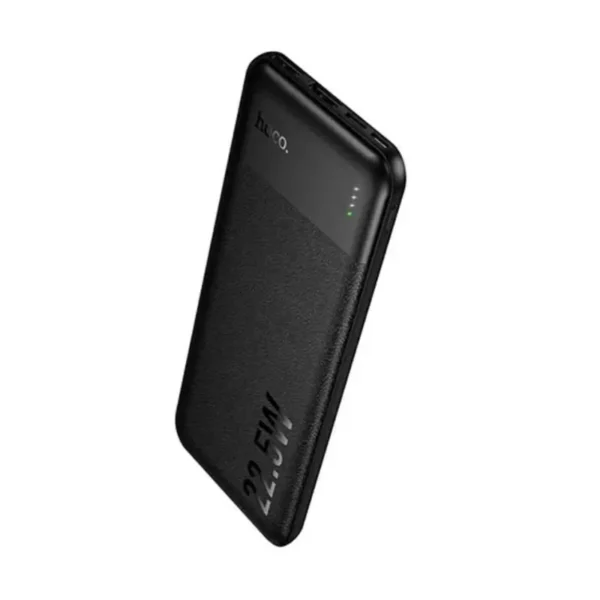
For most customers who travel, the sweet spot is 10,000 to 20,000 mAh: enough for several phone charges, and it clears any checkpoint. Compact 5,000 mAh units, including magnetic packs for iPhone, sell well as impulse buys near the register. Capacities of 30,000 mAh and up have their own market (camping, field work, power outages), but tell buyers they aren’t meant for air travel without approval.
Our selection of wholesale power banks includes brands like Hoco and 1HORA, with the capacity listed on every product page so your team can advise customers with real numbers.
Buying power banks to resell? Never in your luggage
Baggage rules are written for personal use. If you fly to Miami to buy inventory, don’t bring the power banks home in your suitcase: the FAA prohibits carrying batteries for sale or distribution as passenger baggage. Stock for your store has to move as cargo with a forwarder that accepts dangerous goods. Our guide to shipping from Miami to Latin America explains how.
Frequently asked questions
Can I bring a 20,000 mAh power bank on a plane?
Yes. It’s about 74 Wh, under the 100 Wh limit. It has to go in your carry-on and counts toward the two-power-bank maximum.
What about a 30,000 mAh power bank?
At 3.7V that’s roughly 111 Wh, so it needs airline approval. Check the label: if it says more than 100 Wh, ask your airline before you fly.
Can I charge my phone from a power bank during the flight?
ICAO recommends against it, and some airlines restrict it or require the battery to stay within reach. What’s prohibited across the board is recharging the power bank itself on the plane.
How many power banks can I bring?
Under the 2026 ICAO rules, two per passenger at most. Some airlines, such as Southwest, allow only one.
Next step
If you’re refreshing your portable battery assortment, focus on name-brand 10,000 and 20,000 mAh models with the watt-hours printed on them, and walk customers through these rules. EVERIZ keeps stock in Miami with volume pricing: open a wholesale account or message us on WhatsApp to check availability.