Wholesale Volume Pricing and Customer Tiers, Explained
How wholesale pricing really works: quantity breaks, minimum order quantities, spend-based tiers like Pro, Elite and VIP, your true landed cost per unit and ways to lower it without overloading inventory.

In this article
- The three layers of wholesale pricing
- Quantity breaks: buy more, pay less
- Minimum order quantities and case packs
- Customer tiers: Pro, Elite and VIP
- Your real cost: landed cost
- How to buy smarter without overloading inventory
- Example: planning a month of purchases
- Negotiate beyond price
- Common mistakes
- Frequently asked questions
- Next step
In wholesale, a product’s price isn’t a single fixed number. It depends on how many units of that product you buy, how much you buy overall and your history as a customer. Understanding those layers lets you pay less per unit without loading up on stock you won’t sell. This guide explains how quantity breaks, minimum order quantities and customer tiers work, how to figure your real cost and the habits of buyers who consistently buy well.
Key takeaways
- Wholesale pricing has three layers: the base price, quantity breaks on each product and your customer tier based on spend.
- Minimum order quantities and case packs (multiples of 10 or 50) are part of the price, so plan around them.
- Always compare landed cost, including freight and taxes, not just the list price.
- Consolidating orders and planning monthly spend usually saves more than chasing the lowest price on every SKU.
The three layers of wholesale pricing
- Base wholesale price. What an approved business account sees. It’s already below retail.
- Quantity breaks. Each product can drop in price once you buy a certain number of units in the same order.
- Customer tier. Based on your purchase volume, you unlock better pricing across the whole catalog.
Not every wholesaler uses all three, or in the same way. Always ask how they combine before comparing suppliers.
Quantity breaks: buy more, pay less
A quantity break is a unit range with its own price. Here’s how it works:
| Units of the same product | Price per unit | Savings vs. first break |
|---|---|---|
| 1–49 | $5.00 | — |
| 50–199 | $4.60 | 8% |
| 200+ | $4.20 | 16% |
Illustrative example, not EVERIZ pricing. Every product has its own breaks.
The temptation is to always jump to the cheapest break. Before you do, ask yourself how long it will take to sell those units. If 200 chargers last you six months, a 16% savings may not make up for the cash tied up or the risk of the model going stale.
Minimum order quantities and case packs
Many wholesale products come with a minimum (say, 20 units) or sell in multiples (packs of 10), especially when they ship in sealed cases. Some suppliers also set a minimum dollar amount per order. On the EVERIZ website, every product page shows whether an item has a minimum order or sells in multiples, so there are no surprises in the cart.
Customer tiers: Pro, Elite and VIP
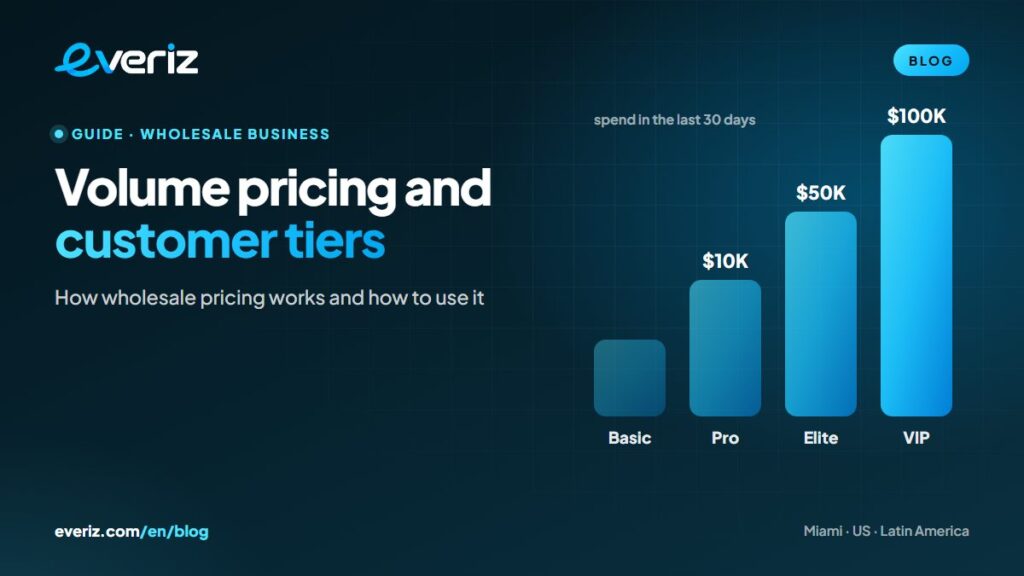
Tiers reward customers who buy consistently. At EVERIZ they work like this:
| Tier | Purchases in the last 30 days | What you get |
|---|---|---|
| Basic | When your account opens | Base wholesale prices |
| Pro | From $10,000 | Better prices for active customers |
| Elite | From $50,000 | Deeper discounts for high-volume businesses |
| VIP | From $100,000 | Our best prices across the catalog |
Because your tier is based on the last 30 days of purchases, it moves with your buying rhythm. Once your account is approved, every product in the catalog shows the price for your tier.
Your real cost: landed cost
The list price is only part of the story. To compare suppliers or decide whether a quantity break makes sense, work out your landed cost:
Landed cost = product price + freight + duties or taxes + payment fees + the cost of tied-up cash. A supplier that’s 3% cheaper but has higher freight or long lead times can end up costing you more.
A quick illustration: supplier A quotes $4.20 per unit and supplier B $4.00, but B charges $0.45 per unit in freight against A’s $0.15, and B’s goods take two extra weeks to arrive. Landed, A comes in at $4.35 and B at $4.45, before you even count the sales you’d lose waiting for stock. The cheaper quote isn’t always the cheaper purchase.
Two things that lower landed cost in Miami: will-call pickup (at EVERIZ, usually ready in about two hours during business hours) skips local freight, and orders of $3,000 or more within 30 miles of Doral get free next-business-day delivery from our team.
How to buy smarter without overloading inventory
- Consolidate orders. One well-planned weekly order hits better breaks than five scattered ones.
- Combine fast movers to reach breaks without overbuying the slow sellers.
- Plan monthly spend. If you’re close to a tier, pulling a restock forward can lower your prices next month.
- Use credit wisely. Approved EVERIZ customers can buy on short-term credit. Use it to sell before you pay, not to buy what doesn’t turn.
- Review inventory monthly. The best price in the world is worthless if the product sits on the shelf.
Example: planning a month of purchases
Picture a store that spends about $9,000 a month across four separate weekly orders. With a little planning, it can buy better without spending more:
- Consolidate restocks into two orders instead of four. Ordering more units of each product at once pushes more SKUs into the second price break.
- Check how far you are from the next tier. If the store is at $9,000 near month-end and Pro starts at $10,000 over 30 days, pulling forward a restock it was going to place anyway can unlock better prices for the following weeks.
- Use pickup for urgent orders and save the big ones for free delivery, if you’re within the zone and above the minimum.
- Cut what doesn’t turn. Cash not tied up in slow movers can go toward reaching better breaks on the products that sell.
Illustrative example: the numbers show the logic, not a purchasing recommendation.
Negotiate beyond price
Once you have a track record with a supplier, price isn’t the only thing you can improve. Payment terms, reserved stock during peak season, samples for testing new products, delivery to your freight forwarder and priority on items in short supply are all negotiable. Sometimes a few days of credit are worth more than a small discount.
Common mistakes
- Buying the cheapest break on a product that barely sells.
- Comparing suppliers without counting freight, taxes or lead times.
- Ignoring minimum order quantities until checkout.
- Never asking how tiers are calculated or how long they last.
If you’re just getting started, our guide on how to start a cell phone accessories business covers margins and how much inventory to buy. And if you’re comparing suppliers, see our 10 questions for choosing a distributor.
Frequently asked questions
How do I move up a tier at EVERIZ?
Your tier is based on your purchases over the last 30 days: Pro from $10,000, Elite from $50,000 and VIP from $100,000. Cross a threshold and you unlock that tier’s pricing.
Can I lose my tier?
Since it’s based on a rolling 30 days, your tier follows your buying rhythm: if purchases drop, it can adjust. Planning your restocks helps you keep it.
Do quantity breaks apply per order or per month?
Usually they apply to units of the same product within a single order. Your tier, on the other hand, depends on your total purchases over the last 30 days.
Where can I see my prices?
Once your account is approved, on every product page on the website or in our B2B app for Android and iOS. For other questions, check our FAQ.
Next step
Work out your landed cost with your current supplier and compare it with what you’d pay by consolidating orders or moving up a tier. To see your prices at EVERIZ, open a wholesale account or message us on WhatsApp.