Shipping Goods from Miami to Latin America: Air vs. Ocean, Dimensional Weight and Lithium Batteries
How to get a wholesale order from Miami to Latin America without surprises: air versus ocean, consolidation at your forwarder's warehouse, dimensional weight, export paperwork, lithium batteries and insurance.

In this article
- Who does what: wholesaler, forwarder and customs
- Air or ocean: how to decide
- Dimensional weight: why a light box can cost a lot
- The paperwork you’ll need
- Lithium batteries: the biggest source of delays
- How to choose a freight forwarder
- How we work with Latin American buyers
- Frequently asked questions
- Next step
Buying well in Miami is only half the job. The other half is getting the goods to your country without freight eating your margin, without lost cartons and without weeks of delay over a missing document. Miami is home to cargo airlines, ocean carriers and freight forwarders that serve all of Latin America, so there’s an option for every kind of order. This guide covers how to choose between air and ocean, how dimensional weight is calculated, which documents you’ll need and what to do about lithium batteries, the single biggest cause of delays on accessory shipments.
Key takeaways
- The wholesaler delivers in Miami, your freight forwarder consolidates and ships, and your customs broker clears the goods at destination.
- Air is fast and billed on actual or dimensional weight; ocean costs less per unit of volume but takes weeks.
- A big, light carton can bill as if it weighed twice as much: dimensional weight wins.
- Power banks and other batteries are dangerous goods, so confirm your forwarder accepts them before you buy.
Who does what: wholesaler, forwarder and customs
A typical purchase involves three players. The wholesaler sells, invoices and delivers the goods in Miami. The freight forwarder receives them at its warehouse, checks them in, consolidates them with your other purchases, prepares the export paperwork and books air or ocean freight. At destination, a customs broker handles the import: duties, taxes and permits. Getting all three aligned from day one prevents most problems.
If you’re still choosing a supplier, start with how to buy wholesale in Miami for export to Latin America: accounts, payment and delivery.
Air or ocean: how to decide
| Mode | Transit | How it’s billed | Best for |
|---|---|---|---|
| Air freight | Days | Per kilo, on the greater of actual or dimensional weight | Urgent restocks and high-value, low-volume goods (screens, earbuds, watches) |
| Ocean, less than container (LCL) | Weeks | Per cubic meter or per metric ton, whichever is greater | Mid-size orders that aren’t urgent; cases, cables, bulky accessories |
| Full container (FCL) | Weeks | Per container | Large, regular volumes; appliances and power stations |
Many buyers mix both: urgent or expensive items by air, volume restocks by sea. Ask your forwarder for its departure days to your country and realistic transit times, which vary by route.
Dimensional weight: why a light box can cost a lot
Air freight is billed on the greater of two weights: what the scale says and the dimensional (volumetric) weight, which reflects the space a carton takes up on the plane. The most common international standard divides the volume in cubic centimeters by 6,000, which works out to 166 cubic inches per pound.
Example: a 60 × 40 × 40 cm carton (about 24 × 16 × 16 in) has a volume of 96,000 cm³. Divided by 6,000, that’s 16 kg of dimensional weight. If the carton weighs 9 kg on the scale, you pay for 16. Some courier services use a 5,000 divisor, which raises the billable weight even more.
To lower the bill, ask your forwarder to consolidate your purchases into fewer cartons and palletize when it makes sense. What you shouldn’t do is strip the retail box off each product: your customers expect original packaging, and without it the goods lose value.
Ocean LCL follows similar logic, billed per cubic meter or per metric ton, whichever is greater. Dense freight (screens, batteries, tools) uses space better than bulky items like blister-packed cases or mounts.
The paperwork you’ll need
- Commercial invoice from the supplier, with clear descriptions, quantities and values.
- Packing list showing the contents, weight and dimensions of each carton.
- Electronic Export Information (EEI) filed in the US Automated Export System (AES) when the value per Schedule B number exceeds $2,500 or the goods require a license, according to the International Trade Administration. Your forwarder usually files it as your authorized agent.
- Certificate of origin, if you want to claim preferential duty under a trade agreement. Keep in mind that origin is where the product was made, not where it ships from. An accessory manufactured in Asia doesn’t qualify for a US trade agreement’s preferential rate just because you bought it in Miami.
- Permits or registrations at destination, such as type approval for radio equipment (phones, routers, Bluetooth devices) in some countries. Your customs broker will know what applies to each product.
Lithium batteries: the biggest source of delays
Lithium batteries ship as dangerous goods under their own set of rules:
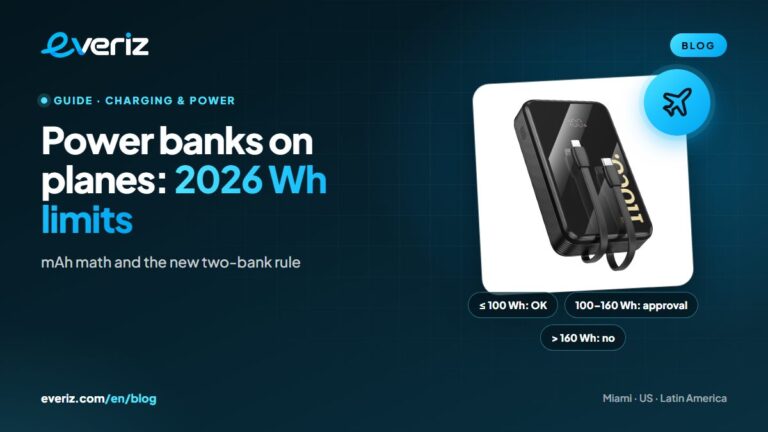
- Standalone batteries, including power banks (UN 3480): by air they can only fly on cargo aircraft, never on passenger planes, at a state of charge no higher than 30%.
- Batteries packed with equipment (UN 3481): since January 1, 2026, those over 2.7 Wh must also ship at 30% charge or less.
- Batteries installed in equipment (phones, watches, earbuds): fewer restrictions, but they still need the right labels and documentation.
IATA publishes the full rules. In practice, not every forwarder accepts dangerous goods, and the ones that do usually add a surcharge, so ask before you buy. Ocean freight accepts them too, with its own declaration. And don’t try to carry inventory in your luggage: the FAA prohibits carrying batteries for sale or distribution as passenger baggage. We cover that in our guide to power bank airline rules.
How to choose a freight forwarder
- Check credentials. In the US, ocean transportation intermediaries need a license from the Federal Maritime Commission (FMC). Ask for the number and verify it.
- Ask about your lane. Departure frequency to your country, real transit times and whether service is door-to-door or airport-to-airport.
- Get the rate details. Dimensional divisor, per-shipment minimums, dangerous goods surcharges, storage and insurance.
- Insist on cargo control. Check-in photos, carton counts, damage reports and shipment tracking.
- Buy insurance. Declare the real value of the goods. Good cargo insurance costs little compared with a loss.
How we work with Latin American buyers
At EVERIZ you can open a wholesale account from your country, buy at your tier’s prices and pay by wire transfer. We deliver within the US only: pick up at our Miami location, where orders are usually ready in about two hours during business hours, or we drop the order at your freight forwarder. Orders of $3,000 or more going to a forwarder within 30 miles of Doral get free next-business-day delivery. Every order ships with its invoice and packing list.
Frequently asked questions
Does EVERIZ ship directly to my country?
No. We deliver within the US: you can pick up in Miami, or we can take the order to your freight forwarder, who handles the international leg.
What is consolidated freight?
It’s combining purchases from different suppliers, or different customers, into a single shipment to share transport costs. Your forwarder receives everything at its warehouse and ships it together.
Can power banks go by air?
As cargo, yes, but only on cargo aircraft, at 30% charge or less and through a forwarder that accepts dangerous goods. Many buyers prefer to send them by sea.
Which documents do I need to import in my country?
It depends on the country and the product. At a minimum, a commercial invoice and packing list; some radio equipment also needs type approval. Check with your customs broker before you buy.
Next step
Sort out the logistics with your forwarder first (lane, rates and whether it takes batteries), then build your order with freight in mind. If you’d like help coordinating delivery, open a wholesale account, visit our contact page or message us on WhatsApp.