Portable Power Stations for Florida Businesses: An EcoFlow Sizing Guide for Hurricane Season
How to size a portable power station for a Florida business: list your loads, do the watt-hour math, choose between EcoFlow RIVER and DELTA models, plan solar recharging and keep generator safety in mind.

In this article
- Power station or gas generator?
- Step 1: list what you need to keep on
- Step 2: calculate the watt-hours you need
- Step 3: check output and surge
- RIVER or DELTA: which EcoFlow line?
- Solar recharging and LiFePO4 batteries
- Keep the register running: backup mode
- Before the season: a prep checklist
- Frequently asked questions
- Next step
In Florida, hurricane season runs from June 1 to November 30, with the historical peak around September. For a business, an outage that lasts hours or days means a closed register, inventory at risk and customers who go elsewhere. Portable power stations, such as EcoFlow’s RIVER and DELTA lines, keep the essentials running without noise or fumes. This guide will help you figure out how much energy you need, choose the right model and get ready before the storm arrives.
Key takeaways
- A power station is a large battery with a built-in inverter: it produces no fumes and can be used indoors, unlike a gas generator.
- To size one, add up the watt-hours (Wh) your devices use in a day and add a 20% buffer.
- Also check the output rating (W) and surge capacity if you plan to plug in a refrigerator.
- With solar panels, you can recharge it during days without grid power.
Power station or gas generator?
A gas generator delivers a lot of power, but it also produces carbon monoxide, an odorless gas that kills. The CDC and FEMA stress that generators belong outdoors only, at least 20 feet from doors, windows and vents, and never in garages or enclosed spaces, even with ventilation. Carbon monoxide poisonings tend to spike after every major storm.
A portable power station runs on a lithium battery and an inverter. It burns no fuel, so you can use it inside your store; it’s quiet and there’s no engine to maintain. Its limit is capacity: once it’s drained, you recharge it from the grid, a vehicle or solar panels. For a business that needs to keep the register, internet, lights and phones going, it’s usually the most practical option. The power outage guide on Ready.gov recommends having a plan for everything that depends on electricity.
Step 1: list what you need to keep on
Write down each device, its wattage (printed on the label or power adapter) and how many hours a day you need it. These approximate figures are a useful starting point:
| Device | Approximate draw |
|---|---|
| Internet router and modem | 10–20W |
| Laptop while charging | 45–65W |
| Card terminal or tablet POS | 5–15W |
| One full phone charge | About 15 Wh |
| LED bulb | 8–12W |
| Pedestal fan | 30–60W |
| Security cameras with recorder | 10–40W |
| Efficient household refrigerator | 100–200W while the compressor runs, with a startup surge several times higher |
For guidance only: your devices’ actual ratings are on their labels.
Step 2: calculate the watt-hours you need
Multiply each device’s wattage by its hours of use and add it all up. Then add 20% for inverter losses and so you don’t run the battery completely flat.
Example for a small store through one day without power: router and modem (15W × 12 h = 180 Wh) + laptop (60W × 6 h = 360 Wh) + four LED bulbs (40W × 6 h = 240 Wh) + four phone charges (4 × 15 Wh = 60 Wh) = 840 Wh. With the 20% buffer, that’s about 1,000 Wh: a station of roughly 1 kWh covers the day.
Step 3: check output and surge
Capacity (Wh) tells you how long the energy lasts; output (W) tells you how many devices can run at once. Everything you plug in at the same time has to stay below the station’s continuous output. Devices with motors, such as refrigerators, pumps and some tools, need a startup surge well above their running wattage, so confirm the station can handle it.
RIVER or DELTA: which EcoFlow line?
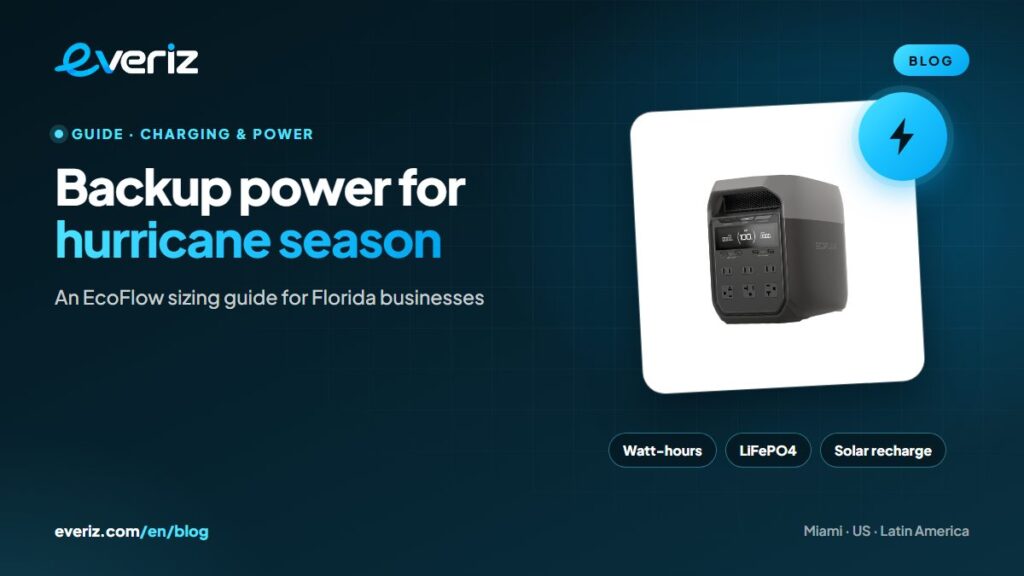
EcoFlow splits its power stations into two main lines: RIVER, which is more compact and portable, and DELTA, built for bigger loads and backing up several devices. Here are some models with their listed specs:
| Model | Capacity | AC output | Good for |
|---|---|---|---|
| RIVER 3 (230) | 230 Wh | 300W (600W surge) | Router, lights and phones for a few hours |
| RIVER 2 Max | 512 Wh | 500W | A small counter with a register and internet |
| RIVER 2 Pro | 768 Wh | 800W | A small office with a laptop and monitor |
| DELTA 3 / DELTA 3 Plus | 1,024 Wh | 1,800W (3,600W surge) | A full store day; a small refrigerator |
| DELTA 3 Max | 2,048 Wh | 2,400W | Several devices and longer outages |
| DELTA Pro | 3,600 Wh, expandable | 3,600W (7,200W surge) | Serious backup for a business or home |
Specs as listed by the manufacturer. Availability changes with the season, so check with us.
EVERIZ is an authorized EcoFlow distributor in Miami. If you’re after a specific model, ask about availability and restock times before peak season.
Solar recharging and LiFePO4 batteries
Many current power stations use LiFePO4 (LFP) batteries, which last thousands of charge cycles and are more stable than other lithium chemistries. For multi-day outages, a portable solar panel lets you recharge the station during the day and use it at night. Real output depends on sunlight and panel angle, so size with room to spare and test the setup before you need it.
Keep the register running: backup mode
Some models can stay plugged into the grid and switch to battery automatically when the power drops, much like an uninterruptible power supply. For a register, router or computer, that prevents reboots and lost data. Check the spec sheet to see whether the model offers this feature and how fast it switches over.
Before the season: a prep checklist
- Charge the station to 100% and test it once a month with your actual devices.
- Store it somewhere dry and cool, away from where water could get in.
- Keep the extension cords and charging cables you’ll need close at hand.
- If you have a solar panel, test it ahead of time and decide where it will go.
- Stock power banks for your team’s and your family’s phones.
- Review the supply checklist from the Florida Division of Emergency Management.
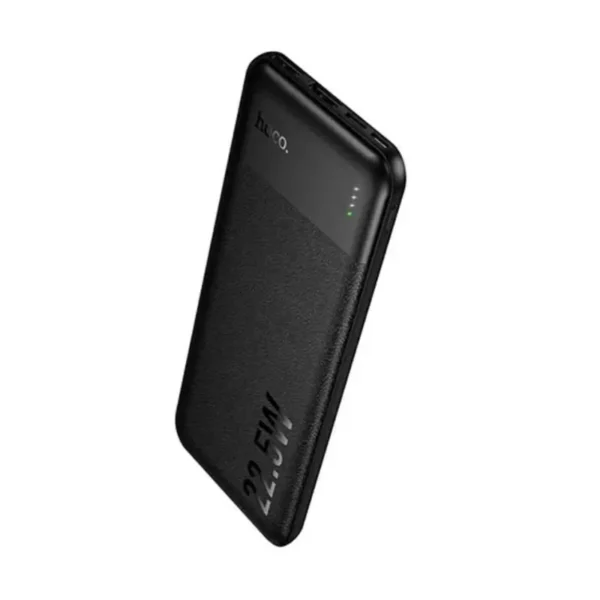
To keep phones charged during an outage, a good selection of power banks complements a power station, and it’s a reliable seller during the season.
Between storms, follow the manufacturer’s storage guidance: lithium batteries slowly lose charge over time, so check the level every few months and top it up before the season starts. A station that has been sitting forgotten in a closet won’t help much on the day the lights go out.
Frequently asked questions
Can I use a power station inside my store?
Yes. It doesn’t burn fuel or give off fumes, so it can be used indoors. Follow the manufacturer’s guidance on ventilation and operating temperature.
How long will a 1 kWh station run a refrigerator?
It depends on the refrigerator’s average draw, since compressors cycle on and off. Divide the available watt-hours (minus 15–20% for losses) by its average hourly draw. First, make sure the station can handle the startup surge.
Can a power station connect to my building’s electrical panel?
Some models integrate with transfer switches or home backup kits, but a licensed electrician must install them. Never plug a power station or generator directly into a wall outlet.
Which is better for a business, RIVER or DELTA?
For a router, register, phones and lights for a few hours, a RIVER is usually enough. For full days, small refrigerators or several devices at once, go with a DELTA.
Next step
List your loads, calculate the watt-hours and choose a model with headroom. If you want to sell power stations in your store or equip your business before the season, open a wholesale account, visit our contact page or message us on WhatsApp to check availability.